
Distinguished medical scientists honoured
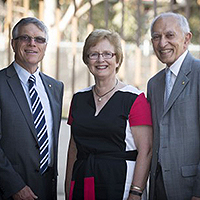 Monash University has awarded two of Australia’s most distinguished medical scientists with this year’s David de Kretser Medal and Lifetime Achievement Award.
The Faculty of Medicine, Nursing and Health Sciences introduced the awards in 2005 to acknowledge contributions to the faculty and to medical science in general.
This year’s recipients are esteemed researchers Professor Suzanne Cory AC, who has been awarded the Lifetime Achievement Award; and Professor Phillip Nagley AM, who has been awarded the David de Kretser Medal.
Dean of the Faculty of Medicine, Nursing and Health Sciences, Professor Christina Mitchell, acknowledged that both the scientists had made an extensive impact on education and medical research.
"Professor Nagley has made an enormous and sustained contribution to undergraduate and post-graduate education and biomedical research in the Department Biochemistry and Molecular Biology at Monash University for four decades, and he is a worthy recipient of the David De Kretser Medal," Professor Mitchell said.
“The Lifetime Achievement Award winner, Professor Cory, has undertaken seminal studies investigating how cell death is regulated. These studies may lead to the development of more effective therapeutics for cancer.”
Professor Nagley is best known for his research work on mitochondria, in both yeast and mammalian cells. He is an adjunct with the Department of Biochemistry and Molecular Biology at Monash, where he holds the title of Professor Emeritus. His research career spans more than 45 years, mostly at Monash. He is also Honorary Professorial Fellow at Florey Institute of Neuroscience and Mental Health, University of Melbourne.
Professor Cory is one of Australia's most distinguished molecular biologists. She was Director of The Walter and Eliza Hall Institute and Professor of Medical Biology of the University of Melbourne from 1996 to 2009. She is currently an Honorary Distinguished Professorial Fellow in the Molecular Genetics of Cancer Division at the Walter and Eliza Hall Institute of Medical Research and a Vice-Chancellor’s Fellow of the University of Melbourne.
Professor Cory’s research has had a major impact on the understanding of the immune system and the development of cancer.